
Why it pays to help subject matter experts create courses
For decades, expert knowledge has had to pass through a central learning team before it reached learners. Subject matter experts provide the content, and L&D turns it into a learning experience. It doesn’t always have to work that way.
The most common problem I see in learning projects is rarely a lack of expertise. Experts spend more time explaining their knowledge to course creators than helping to create the learning. Today’s Articulate products have lowered the technical barrier enough that SMEs can build much of it themselves.
Some organizations already work this way. One of our customers has been very successful with this workflow. SMEs create the content, and the L&D department hands out the tasks, gives the experts tool training and help along the way, and oversees production and distribution. The experts build content in Articulate, and L&D makes sure it works.
That makes L&D just as important as before. Not every SME has the time, interest or confidence to build a course, and some topics still need a traditional process led by L&D. The aim is to make SME-led creation a real option when speed, ownership and scalability matter.
Articulate offers two different products: Articulate 360 AI, mainly for L&D, and Frontline, for teams creating training outside of L&D. How SMEs and L&D collaborate differs, but the three steps below work for both. What changes is how each step looks in practice. If you’re still deciding which tool fits which team, we compare both in Articulate 360 AI vs. Frontline. If you already work with Articulate, here’s what the launch of Articulate 360 AI and Frontline means for existing customers.
Step 1: Set the design frame before anyone builds
When course creation is spread across an organization, courses can quickly start to look different depending on who built them. Layouts, colours and interaction patterns vary, learners get an inconsistent experience, and every expert makes the same design decisions from scratch. A clear framework set up front saves everyone that work.
SMEs know their subject, and that’s where their time is best spent. Visual design, instructional design and learning technology are L&D’s strengths. In Articulate, you set up a brand at subscription level with your fonts, colours and logo, and it’s applied automatically. This works in both Articulate 360 AI and Frontline.
In Articulate 360 AI
Here you can take the framework further. A tip I often recommend is to prepare a small library of reusable block templates as well. A handful usually covers most of what an SME needs:
- A key-takeaway block for essential information
- A step-by-step block for processes and procedures
- A scenario block for workplace decisions
- A knowledge-check block for practice and feedback
- An expert-tip block for practical advice and common mistakes
Templates also teach. An expert explaining a customer process starts with the step-by-step template. Someone creating compliance learning uses the scenario template to show how a policy applies in a realistic situation. If your team is new to Articulate 360 AI blocks, these Articulate 360 AI features most teams underuse are a good place to start.
In Frontline
In Frontline, the framework comes built in. The subscription brand is applied to every artifact in a kit, and each artifact format gives its content a set structure, so experts always start from a clear format. Where an artifact needs a final touch, experts adjust its style directly in that artifact.
Step 2: Let AI turn source material into a first draft
Most subject matter experts have plenty of content, spread over years of presentations, reports, whitepapers, documentation and support articles. The challenge is deciding what belongs in the training, how to organize it and what learners actually need.
In Articulate 360 AI
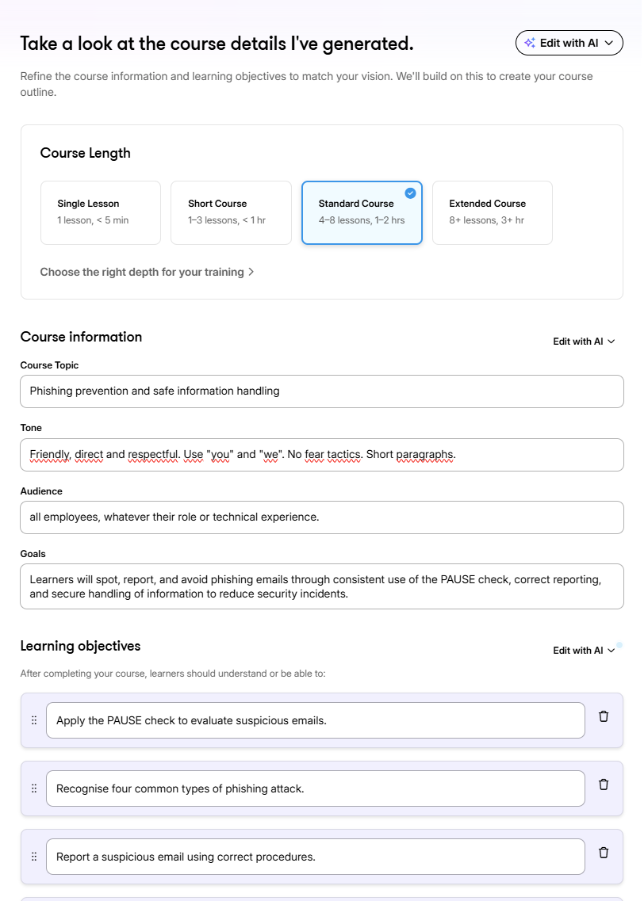
The SME chooses a learning artifact type, uploads relevant source material and briefly describes the learning they want to create (if applicable to the learning format). The AI then suggests learning goals, audiences, topics and a lesson structure, which the expert reviews and refines before generating a first draft. Because the framework from step 1 is already in place, that draft starts on brand.
In Frontline
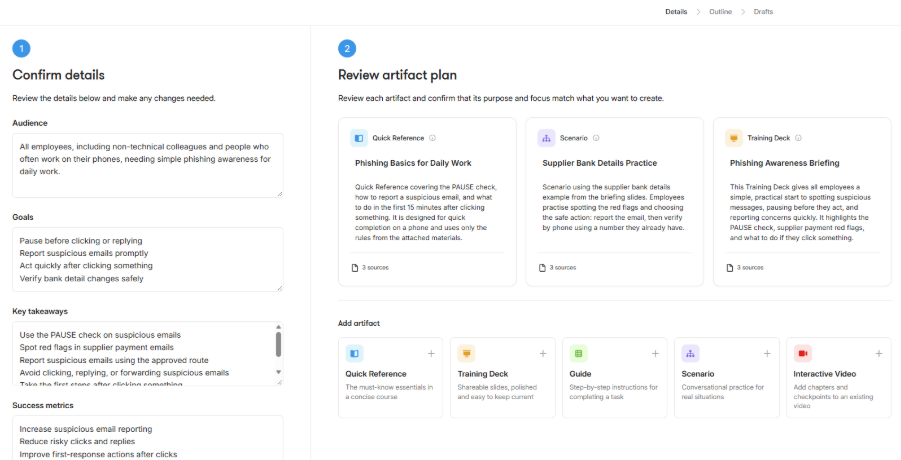
From one set of source files, Nova suggests learning objectives and the training assets that fit, then generates a whole training kit in one go: for example a guide, a quick reference, an interactive video, a scenario or a training deck. One upload gives learners several ways into the same topic.
In both tools, this changes where SMEs spend their time. Instead of sorting through documents and building a structure from scratch, they focus on the work that needs their expertise: validating the content, picking what matters most, adding practical examples and making sure the learning reflects real-world experience.
Expert judgement stays essential. Source material can contain outdated information, unnecessary detail or content that works as documentation but not as learning, so treat AI output as a starting point. In a kit with several formats, a careful review pays off twice, because one outdated fact can show up in each of them.
Step 3: Flip the process. Let L&D review and coach
Traditionally, SMEs support the work of learning professionals. They provide reference material, answer questions and review drafts, while the course creator tries to understand the subject well enough to build something. The person who knows the subject best ends up furthest from the actual creation.
SME-led creation flips the model. L&D becomes a resource for SMEs. The expert creates the first draft, and an L&D specialist reviews it and coaches the expert on structure, interactions and learner engagement.
Both sides gain. SMEs spend less time explaining their subject to an intermediary. L&D professionals spend less time becoming temporary experts in unfamiliar topics, and more time on what they do best: instructional design, accessibility and the learner experience. This step is where quality is secured, so every piece goes through review before it reaches learners.
In Articulate 360 AI
Reviews run through Review 360. Comments receive screenshots automatically, which the reviewer can annotate, and attachments can be added. That makes detailed coaching feedback easy to give in context, which helps with longer courses and richer interactions.
In Frontline
Frontline has its own review functionality built in. Each artifact in a kit goes out for review on its own, and reviewers leave text comments tied to a specific block. That keeps feedback short and focused, which suits the pace of quick training.
Wrapping up: let experts build, let L&D help them build better
Helping subject matter experts create courses shortens the distance between expertise and learning. Brands and templates set the frame, AI turns existing material into a first draft or a complete kit, and L&D coaches the experts and secures the quality.
This gives L&D a more scalable role. Learning professionals create the frameworks that let more people in the organization create effective learning. And experts spend less time explaining their knowledge and more time sharing it.
Planning to let your experts create training in Articulate 360 AI or Frontline? Our trainings and TicTac Support help your team get started fast, use Nova credits well and keep content current.
FAQs: helping subject matter experts create courses
Can subject matter experts create courses or training without instructional design experience?
Yes. Block-based authoring in Articulate 360 AI and the guided kits in Frontline both let SMEs create engaging learning without advanced technical skills. Instructional design principles still matter, though. Coaching from L&D professionals, a set of approved templates and clear guardrails help experts create better learning from the start.
How can AI help SMEs create courses?
AI does the groundwork. In Articulate 360 AI, it suggests learning objectives, a course structure and lesson outlines based on source material, then generates a first draft. Frontline takes this approach even further: Nova turns the same kind of source files into a complete training kit with several formats, ready to share. In both cases, the expert reviews and refines the result before it reaches learners.
Does SME-led course creation replace the need for L&D teams?
No. Successful courses need both subject expertise and learning expertise. SMEs can take a more active role in creating content, and L&D professionals stay central to setting standards, coaching, quality assurance, instructional design, accessibility and learner engagement. Their role shifts from producing every course to enabling others to produce good ones.
Who should review courses created by subject matter experts?
The expert stays responsible for accuracy, because they know the subject best. L&D reviews structure, accessibility, branding and the learner experience, and coaches the expert where needed. When teams outside L&D create training themselves, agree up front who owns each course or kit, which sources are approved and when content gets updated.